Written by Sonia and published on https://extremehowto.com/.
Cutting down a mature tree isn’t as easy as just stroking away at it with an axe. There are particular techniques that need to be followed to preserve the wood and ensure the safety of the people cutting down the tree. To know how a tree will fall, the cutter will need to determine the right kind of cut to use.
Before you begin to study the correct tree trimming method, you need to make sure you have the right tools for the job. The equipment you use should be of good quality and must be tested before utilizing it on a tree. The following list covers the main pieces of equipment that would be needed to cut down a mature tree on your property.
Take Down a Tree
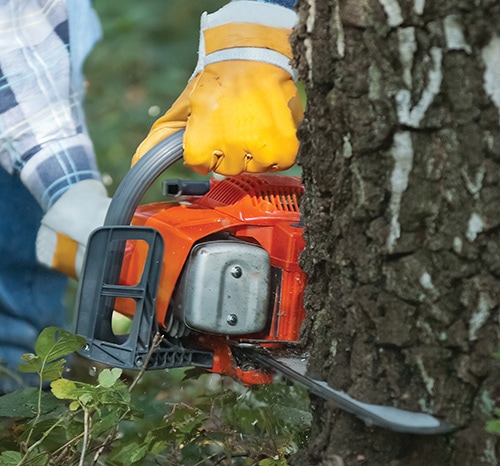
The Right Way to Fell a Tree with a Chainsaw.
Trees are an important part of the ecosystem but sometimes they need
to be removed to prevent damage to surrounding areas. When it comes to
felling a tree, the task is as much art as it is science. To exercise
the proper amount of control to achieve the desired results without
risking safety, the experts at Husqvarna offer the following basics on
felling a tree.
Note that it is impossible to address all scenarios, circumstances and contingencies that can and will occur when felling, so this article is intended to give an understanding of basic principles.
Safety & Preparation
Before firing up the chainsaw, you must have a plan in place. The
very first step is to read (or reread) the chainsaw’s Operator Manual
and follow all instructions, precautions and warnings prior to using the
saw. It is imperative to know the answer to the question “what needs to
be done if an emergency occurs’’ and develop a plan for specific
situations. This will help identify potential hazards beforehand and
create an organized response if an emergency occurs.
An on-site first aid kit, cell phone programmed to the nearest
emergency care facility, directions and distance to that facility and
local utility contact numbers are a few basic components to a good
emergency plan. And, whether in the back yard or the back 40, never work
alone.
While it is mandatory for professionals, anyone using a chainsaw
should include personal protective equipment (PPE) as part of their
plan. A properly outfitted operator wears protective chaps or pants, eye
and ear protection, appropriate footwear, work gloves and a helmet with
visor. The proper equipment cannot eliminate the risk of injury
completely but it can reduce the severity of an injury should an
accident occur.
Before pulling the cord, it is important that users visually inspect the saw for any damage or leaks. Only use a chainsaw that’s been well maintained and is in proper working order. The chain’s cutting teeth need to be properly sharpened, and make sure the depth-gauge setting is correct.
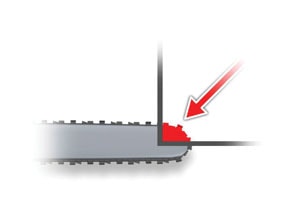
When using a chainsaw, understand the three reactive forces of the saw—push, pull and kickback. Try to avoid kickback, which occurs when the tip of the bar contacts an object or gets pinched during operation. The reactive force causes the bar to “kick” back towards the operator, which can cause injury.
Saw Operation
When using a chainsaw, understanding the three reactive forces of the saw—push, pull and kickback—will help prevent accidents.
Never cut with the upper half of the tip of the bar. Kickback occurs
when the tip of the bar comes in contact with an object or gets pinched
during operation, causing the bar to “kick” up and back towards the
operator, which can result in a loss of control and possible injury.
That is why balance and stance are important to safe operation. The
boxer’s stance, left foot slightly forward and both knees bent, is
recommended to help maintain control of the saw and minimize fatigue
when reactive forces are experienced.
Before
cutting, establish a plan for the direction of the tree to fall as well
as a path for your escape route. When surveying the surrounding area,
identify potential hazards on the ground, in the tree and where the tree
will fall.
Felling Techniques
Directional felling is the process of putting a tree in a preferred
area and not necessarily where it wants to go. A “felling hinge” is the
hallmark of directional felling. It is safe, efficient and steers the
tree as it falls to the ground.
When surveying the tree and surrounding area, identify potential
hazards on the ground, in the tree and where the tree will fall. Clear
leaves, limbs and live saplings or anything that will impede a clean and
controlled cut or complicate the escape route. Look for dead limbs and
hanging branches that could possibly fall when cutting or as the tree
falls. Also, examine the path and area where the tree will fall for
hazards such as potential hang-ups or stumps.
It is exceptionally rare to find a tree that does not lean.
To
determine the lean of a tree, stand back 25 to 50’ and frame the entire
canopy with your hands. Imagine a plumb line running from the center of
the frame down to the base of the tree. The distance left or right of
center will determine the amount of weighted side lean.
The side lean will show which side is the “good” side and the “bad”
side. The side the tree leans toward is considered the bad side of the
tree. The lean will also help determine aim when placing the tree. If a
tree leans three feet to the right, it is necessary to aim three feet to
the left, to have the tree fall in the right location.
Trees with severe lean can be dangerous to fell because the tree can
move in the leaning direction too quickly, splitting at the base and
creating what is known as a “barber chair” break in the tree. In such a
case, the split wood can fly upwards, striking the operator with
terrific force.
The next step is to map out the escape route. This is always opposite
the direction the tree will be falling and should be at a 45-degree
angle from the tree. Remove any obstacles and make note of any potential
hazards such as holes or tree stumps. When the tree begins its descent,
don’t run or turn your back on it.
To
determine the lean of a tree, stand back 25 to 50’ and frame the entire
canopy with your hands. Imagine a plumb line running from the center of
the frame down to the base of the tree trunk. The distance left or
right of center will determine the amount of weighted side lean.
Sounds like a lot of work? Abraham Lincoln is credited with saying,
“Give me six hours to chop down a tree and I will spend the first four
sharpening the axe.” Preparation is central to success.
Next, the hinge will need to be determined. The hinge helps dictate
how and where the tree will fall. Most industry experts will use a
simple formula to calculate both the hinge length and thickness. To
determine thickness, it is recommended to use 10% of the diameter of the
tree at D.B.H (diameter at breast height) or 4-1/2 ft. from the ground.
A tree with a 20-in. diameter will have a 2-in. thick hinge. Hinge thickness is reduced for thicker trees and drier wood fiber.
The length is 80 percent of the tree’s diameter at D.B.H. So, for a 20-in. diameter tree, the hinge length is 16 in.
The hinge of the open face notch helps dictate how and where the tree will fall. To determine thickness, use 10 percent of the diameter of the tree at D.B.H (diameter at breast height) or 4-1/2’ from the ground. A tree with a 20” diameter will have a 2” thick hinge.
Historically, the 45-degree face notch dominated the industry, flat
on the bottom and cutting at a 45-degree angle downward to create the
opening. While this will bring the tree down, there is more risk with
the reduced amount of control in placing the tree. The tree can only
fall 45-degrees before the notch closes and the hinge breaks.
Today, most people recommend using an open-face notch, which is a
70-degree opening. This gives the cutter more control since the hinge
will not be broken until the tree is almost to the ground. The open-face
notch allows the back cut to be made level with the notch, whereas the
45-degree notch will need to be back-cut above the apex of the hinge.
Original post here https://ift.tt/3wxD2E4.
from AAA Tree Lopping Ipswich https://ift.tt/3bSK1je
via IFTTT

 AAA Tree Lopping Ipswich Blog